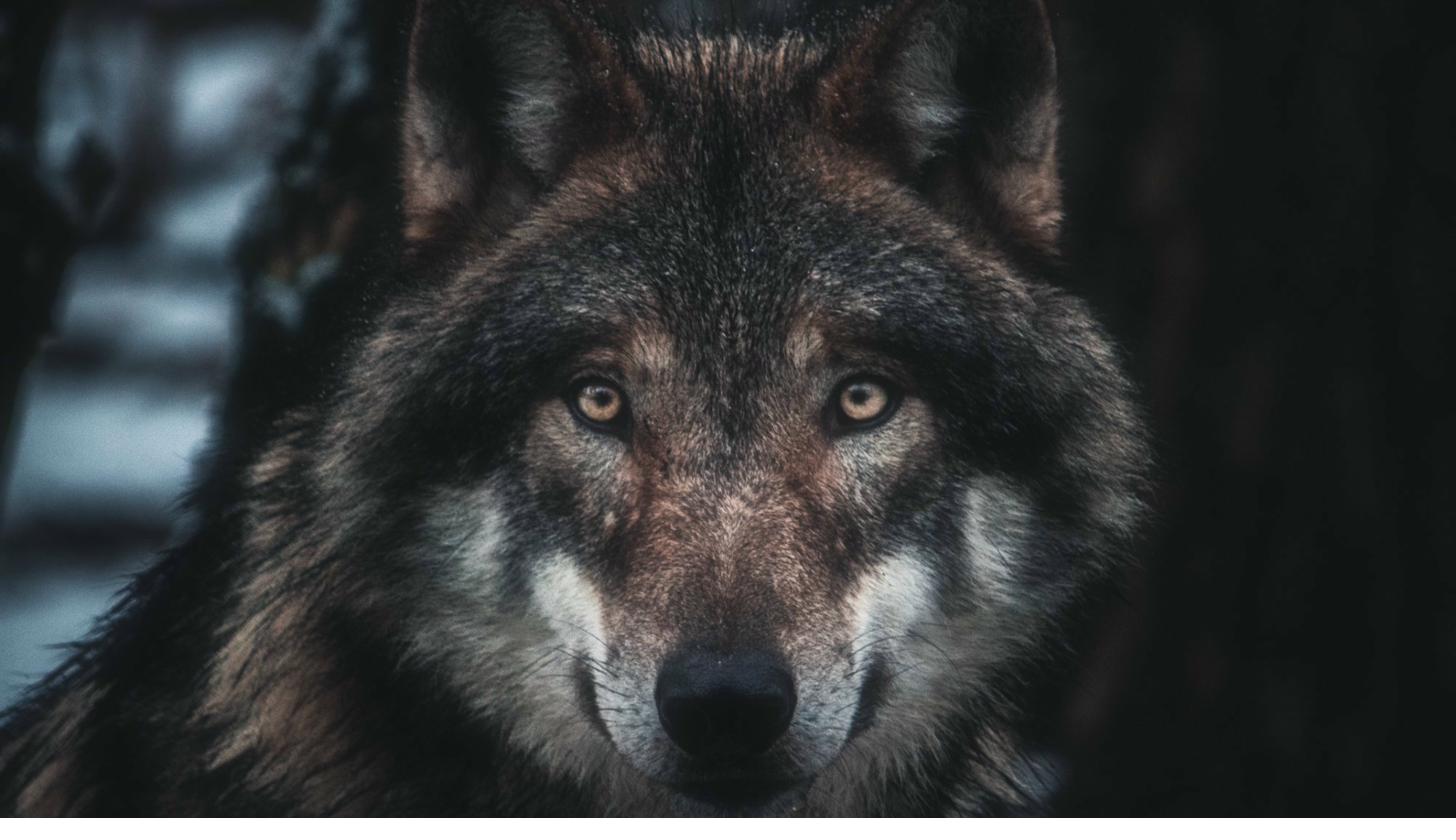
How I See
The alpha myth got it backwards.
Leadership isn't dominance - it's regulation. The wolves who lead absorb risk, coordinate movement, and keep the system intact under pressure.
How I See
Leadership isn't dominance - it's regulation. The wolves who lead absorb risk, coordinate movement, and keep the system intact under pressure.
The Science
The "alpha wolf" came from studies of captive wolves - unrelated animals confined in artificial, stressful environments.
Aggression was exaggerated by confinement. The behavior was pathological, not adaptive.
It persists because it's simple, dramatic, and justifies hierarchical power structures.
Wild packs are family units organized around cooperation. Internal aggression is remarkably low.
Leadership is not seized - it is inherited through responsibility.
The wolves we called "alpha" lead because they coordinate, regulate conflict, and absorb risk.
In natural systems, leadership exists to protect the system itself.
Not to dominate it.
Not to extract from it.
Regulation comes first.
Conflict is contained.
Risk is absorbed before it spreads.
Evolution does not reward the biggest, loudest, or most aggressive. It consistently selects for traits that reduce internal damage, detect stress early, and preserve the system long enough for the next generation to survive.
The true "alpha" is not a tyrant. It is a stabilizer.
The Training
I started in an evolutionary biology lab at the University of Utah, studying how species relate and diverge over time. The work was molecular - PCR amplification, DNA sequencing, phylogenetic analysis. I processed samples, tracked patterns, and helped reconstruct evolutionary relationships across species.
In biology, you observe living systems. You ask why they behave the way they do. There's always a reason - but you don't get to publish unless it's statistically significant. Correlation isn't causation. You learn to find the true signal in the noise.
When I encountered the wolf research years later, I recognized the pattern immediately: the same stabilizing forces that keep ecosystems intact, the same selection pressures that favor regulation over dominance. The science confirmed what the wild already knew.
Observed living systems (birds)
Molecular analysis (PCR, DNA)
Statistical validation required for publication
Observe living systems (supply chains, customer behavior)
Data analysis (ML, Python)
Statistical validation required for action
The Application
Companies, cultures, the way teams interact with each other - it's all observable behavior. And behavior shows up in data. Efficiencies, inefficiencies, friction, flow. They all create the ecosystem.
You have to observe the system to see what moves what. Where the strengths can be amplified. What's sending signals that it's in trouble. The goal is filtering through the noise to tune in the signal - so companies can know when to react, when a ripple is poised to become a tsunami.
This is what the biology training gave me: the ability to watch a living system, find the patterns that matter, and distinguish real signal from random noise. The same method works whether the organism is a species, a supply chain, or a company.
It enables companies to protect the system at the most fundamental level.
Their people. Their jobs. Their legacy.
Ethical sourcing and sustainability aren't moral add-ons - they're what happens when you can finally see the system clearly. When you can read the early signals. When you can act before the damage becomes irreversible. That's system protection. That's how systems endure.
Companies that have the power to not only move supply chains but mold them to their whim - that's a responsibility. A responsibility to protect the product, the species, and the people who work to produce what you sell.
We can improve someone's life. We can protect the longevity of a species and the environment it depends on. But only if we demand better - and know what better looks like.
That's my goal: to improve not only a company's performance, but its impact on the lives of the people who work in the supply chain and are affected by it. The product. The people. The system. All of it, together.
The Frames
Prep before panic. Clean as you go. Think two steps ahead or fall behind fast. Restaurants taught me that wasted motion costs real energy - and that clarity is kindness.
Systems survive when stress is detected early, when damage is repaired instead of ignored, and when extraction never outpaces regeneration.
The alpha myth got it backwards. Leadership isn't dominance - it's regulation. The wolves who lead absorb risk, coordinate movement, and keep the system intact under pressure.
Every customer is a relationship, not a transaction. The best reps know who's price-sensitive, who rewards loyalty, who's about to lapse. That knowledge doesn't scale - unless you codify it.
Hypothesis, test, fail, revise. I don't build systems to prove I'm right - I build systems to find out I'm wrong. Fast, cheap, and before it scales.
Show me your weakness, and I'll make it irrelevant. I see broken systems as puzzles, not problems. The question isn't whether it can be fixed - it's whether anyone's willing to try.
I didn't write 140,000 lines of code.
I wrote over 500,000 lines to find the 140,000 that worked.
That's not coding - that's the scientific method. Hypothesis, test, fail, revise, test again. Over and over until what's left is what actually works.
The goal isn't to be right. The goal is to find out you're wrong while it's still cheap to fix. That's why I build experiments before rollouts. That's why I validate signals before I prescribe actions. That's why every system I build has a feedback loop.
Decisions ripple outward, whether acknowledged or not.
You cannot protect a system while harming those who sustain it.
Stress ignored becomes failure.
Listening early prevents collapse.
Values only matter when actions match them.
Short-term efficiency that erodes long-term capacity is not success.
Good systems protect people.
Confusion costs real energy.